Vintage ribbed cardigan sweater (1918)
A hard-wearing ribbed cardigan in Germantown wool, with row-by-row shaping and advice on knitting a test swatch.
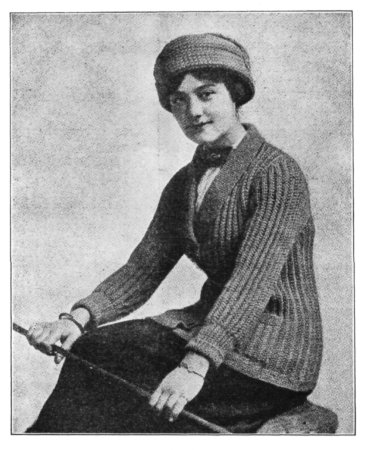
About this pattern: this is a real pattern published in 1918, reproduced word for word. Knitting terms have hardly changed since then; the few old words (such as “narrow” and “seam”) are explained in the glossary below.
Pattern (original 1918 text)
Use fourfold Germantown zephyr and a pair of No. 5 needles, with one pair two sizes smaller. As the sizes or numbers of needles vary, and also do methods of knitting, it is a good plan to work a little block before beginning the pattern. Cast on, say, 12 stitches, knit across and purl back, repeating these two rows until you have a square. There should be 5 stitches to the inch in width, and seven rows should make an inch in length. If you get less, use larger needles, say No. 6.
It is also a good plan to practise on the pattern a little, so that you will become familiar with it and can narrow or widen and still keep the ridge. Cast on any number of stitches divisible by four, with one stitch over, knit 2, purl 2, until but one stitch remains, and knit that. All rows are the same, the odd stitch breaking the rib and making a ridge. When you come to the decreasing later you can tell whether you are keeping the pattern correct, by watching the knitted stitch, which forms a sort of chain right on top of the ridge, and must be kept throughout.
Left front: Cast on 65 stitches on the larger needles and knit 12 rows plain for the band at lower edge.
13. Knit 10 (these stitches are for the plain border up the front), * purl 2, knit 2, repeat from *, knitting last stitch.
14. Slip 1, purl 1, * knit 2, purl 2, repeat from *, knitting last 10. Repeat these two rows until you have 110 rows in all.
111. Knit 2, narrow, knit 6; finish row in pattern.
112. In pattern until 9 stitches remain, knit these.
113. Knit 2, narrow, knit 5; continue in pattern.
114. In pattern, knitting last 8 stitches.
115. Knit 2, narrow, knit 4; continue in pattern.
116. Like 114th, knitting 7 at end.
117. Knit 2, narrow, knit 3; continue in pattern.
118. Like 114th, knitting last 6.
119. Knit 2, narrow, knit 2; continue in pattern.
120. Bind off 3, knit in pattern to within 5 stitches of end, knit these.
121. Knit 2, narrow, knit 1; continue in pattern.
122. Like 120th row, knitting 4 at end.
123. Knit 2, narrow; continue in pattern.
124. Like 120th row, knitting 3 at end.
125, 127, 129. Like 123d row.
126, 128. Bind off 1, knit in pattern until 3 stitches remain, knit these.
130. Knit in pattern until 3 stitches remain, knit these.
Continue to work until you have completed the 171st row, doing the odd rows like the 123d and even rows like 130th, when you should have 23 stitches on the needle. From this point work until you have completed the 183d row, increasing at beginning of 172d, 176th and 180th rows by knitting in the back, then in the front of the 2d stitch. You should then have 20 stitches on the needle. Knit one plain row (the 184th) and bind off.
Right front: Begin like left front, doing 12 plain rows.
13. Knit 10, * knit 2, purl 2, repeat from * to end, knitting last stitch.
14. Knit 2, purl 2, repeat until 11 stitches remain, purl 1, knit 10. Repeat last two rows until you have 27 rows in all.
28. Knit as usual until you have the 10 border stitches remaining, knit 3, bind off 3, knit 4.
29. Knit 4, cast on 3, knit 3, and continue as usual. This forms the buttonhole. Make five buttonholes at equal distances apart, and begin the narrowing for collar in the 11th row, continuing like left front.
Back: Cast on 79 stitches and knit 12 rows plain; then work in the pattern until you have 120 rows in all, which brings the work to the armhole.
121. Bind off 2 stitches and knit remainder as usual, taking care to keep the pattern. Repeat this row seven times, when you will have taken 8 stitches from each side. Knit 48 rows in pattern on the remaining 63 stitches.
177, 178. Knit in pattern until within 7 stitches of the end; turn, leaving these stitches on left-hand needle without knitting.
179, 180. Knit in pattern to within 13 stitches of the end (including the 7 stitches previously left), turn.
181, 182. Knit in pattern to within 19 stitches of end, turn.
183. Knit 4, narrow, (knit 5, narrow) twice, knit rest plain, to end of needle.
184. Knit plain entirely across, and bind off.
Sleeves. Cast on 97 stitches.
1. Knit 40, * purl 2, knit 2, repeat from * 3 times, purl 1, turn.
2. Slip 1, knit 1, * purl 2, knit 2, repeat from * 4 times, knit 1, turn.
3. Slip 1, knit 1, * purl 2, knit 2, repeat from * 5 times, purl 2, knit 1, turn.
4. Slip 1, purl 1, * knit 2, purl 2, repeat from * 7 times, knit 1, turn.
5. Slip 1, purl 1, * knit 2, purl 2, repeat from * 8 times, knit 3, turn.
6. Slip 1, knit 1, * purl 2, knit 2, repeat from * 10 times, knit 1, turn.
7. Slip 1, knit 1, * purl 2, knit 2, repeat from * 11 times, purl 2, knit 1, turn.
8. Slip 1, purl 1, * knit 2, purl 2, repeat from * 13 times, knit 1, turn.
9. Slip 1, purl 1, * knit 2, purl 2, repeat from * 14 times, knit 3, turn.
10. Slip 1, knit 1, * purl 2, knit 2, repeat from * 16 times, knit 1, turn.
11. Slip 1 knit 1, * purl 2, knit 2, repeat from * 17 times, purl 2, knit 1, turn.
12. Slip 1, purl 1, * knit 2, purl 2, repeat from * until but 7 stitches remain, turn.
13. Like 12th row, leaving 4 stitches at end.
14. Slip 1, knit 1, * purl 2, knit 2, repeat to end, knitting last stitch.
15. Slip 1, purl 1, * knit 2, purl 2, repeat to end, knitting last stitch. Continue to knit in pattern, decreasing at beginning and end of every 8th row until 73 stitches remain, then knit without decreasing until you have 120 rows, counting from the 15th row.
Take the smaller needles and commence the cuff on the sleeve-stitches as follows: Slip 1, (narrow, knit 2) 3 times, (narrow, knit 1) 14 times, narrow, knit 2, to end of row.
Repeat last 3 rows until you end with 2 stitches and bind off.
Pockets.—With the larger needles cast on 23 stitches.
1. Knit 1, * knit 2, purl 2, repeat from * across, ending with knit 2.
2. Slip 1, * purl 2, knit 2, repeat, ending with purl 1, knit 1.
3. Slip 1, * knit 2, purl 2, repeat, ending with knit 2.
Repeat last two rows until you have 32 rows in pattern, then knit 10 rows plain for top of pocket and bind off.
To make up the coat, first press the border of fronts; stretch into shape, pin to an ironing-board, cover with a damp cloth and press with a fairly hot iron until the cloth is dry. This will prevent the coat from drawing up, as the ribs are inclined to do. For sewing, use a blunt-pointed needle to avoid splitting the wool. Sew up the side and shoulder-seams, taking a stitch from each edge and keeping the edges perfectly even, being careful not to draw the sewing-yarn so tightly as to pucker the seam in the least. Sew up the sleeves, and place the sleeve-seam an inch to the front of the side-seam, easing in any fulness there is around the top. Place the center of collar at center of back before sewing on; this must be done on right side of coat, and the collar turned over. Sew on the pockets, matching the ridges, and sew on five pearl or bone buttons, about three-fourths of an inch in diameter, to correspond with the buttonholes, placing a small pearl button at the back of the larger one on wrong side of coat and sewing through both together.
This coat measures twenty-six inches from shoulder to hem. It may easily be made longer, if desired, but the model is an excellent one for ordinary wear, and very "natty," and it has the merit of being quickly knitted.
As has been suggested, a good way to do, when knitting a sweater in any stitch, is to have a pattern and work to fit that. First, have a coat cut from any old cloth, and of any style desired. Seam it up and try it on, having it fitted nicely, then cut along the seam and take apart. Fasten the different parts on a smooth surface by means of thumbtacks and knit to measure, without stretching your work.
Old knitting terms
| In the 1918 book | Today |
|---|---|
| plain / knit plain | knit |
| purl, seam or seam-stitch | purl |
| narrow | decrease: knit 2 together (k2tog) |
| widen | increase |
| over | yarn over (yo), which makes a new stitch and a small hole |
| slip and bind | slip 1, knit 1, pass the slipped stitch over (skp) |
| slip, narrow and bind | slip 1, knit 2 together, pass the slipped stitch over (sk2p) |
| rib (when knitting plain back and forth) | a garter ridge: 2 rows make 1 rib |
| double rib | knit 2, purl 2 rib |
| bone, amber or steel needles | needles made of those materials |
| No. 11–17 steel needles | old wire-gauge numbers: the higher the number, the thinner the needle |
| Red Cross needles No. 1, 2, 3 | wartime needle sizes; choose by the gauge given (stitches per inch) |
Some knitting patterns use a crochet edging. In this book a crochet “double” is today's US single crochet (sc) and a “treble” is a US double crochet (dc).
1918 yarn names today
Approximate modern equivalents. Old yarns were often finer than today's, so knit or crochet a swatch first and compare it with any measurements the pattern gives.
| 1918 yarn | Closest modern choice |
|---|---|
| Knitting-worsted | worsted weight (#4) |
| Germantown wool or zephyr (fourfold) | roughly worsted to aran weight (#4) |
| Saxony | a fine yarn, roughly fingering to sport weight (#1–2) |
| Shetland floss | a very fine, soft wool, roughly lace to light fingering weight (#0–1) |
| Angora | a fluffy angora yarn; any soft brushed yarn gives a similar effect |
Source
Handbook of Wool Knitting and Crochet, Needlecraft Publishing Company, Augusta, Maine, 1918. This book is in the public domain in the United States. A digital edition is available free from Project Gutenberg.
More vintage knitting patterns
- Vintage basket-stitch sleeveless sweater (1918)
- Vintage winter sweater and skating cap (1918)
- Vintage child's hood, scarf and sweater set (1918)
- Vintage baby jacket and hood set (1918)
- Vintage ladies' sweater with angora trim (1918)
- Vintage gloves with lace backs (1918)
- Vintage slippers with “ermine” trim (1918)
- Vintage baby long bootees (1918)
- All vintage knitting patterns
Looking for something new? Browse our free modern patterns, the crochet and knitting guides and the free yarn calculator.