Vintage slippers with “ermine” trim (1918)
Pretty slippers knitted from a square, with white trim spotted in black to look like ermine and a ribbon bow.
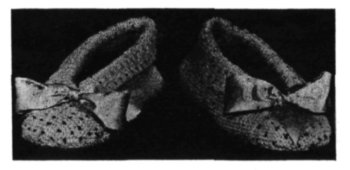
About this pattern: this is a real pattern published in 1918, reproduced word for word. Knitting terms have hardly changed since then; the few old words (such as “narrow” and “seam”) are explained in the glossary below.
Pattern (original 1918 text)
Materials required are three skeins fourfold Germantown yarn, two colors, and one yard of ribbon. Pink and white yarn, with a little black, and pink ribbon are used for the slippers illustrated.
Cast on 15 stitches with white yarn, using medium-size steel needles. Knit back and forth until you have a perfect square of white, then join the color. The square is for the toe of slipper.
Knit back and forth on the 15 stitches until you have a strip long enough to extend around the sole of slipper and join to the square on other side, leaving two sides and one corner for the toe.
Darn the white with black; beginning at lower right-hand corner, bring the needle through the first two ribs and down between next two, miss three ribs, keeping the long thread on the wrong side, and repeat, having every other row alternate. This may be done before the strip is joined to opposite side of square, if more convenient. Sew to the sole, using strong thread and over-and-over stitches. The strip should be stretched somewhat during the sewing, in order to make the slipper cling well to the foot.
For the border: Cast on 10 stitches with white and knit plain, back and forth, until the strip is long enough to go around the top. Darn with the black yarn, making three rows, over one rib and under three, alternating the stitches. Sew to top of slipper, turn back, and put on the bows.
These slippers are very easily knitted, extremely pretty and may be made to fit any size of sole. For a larger slipper cast on an additional number of stitches for the square, which will make the strip proportionally wider; knit it long enough for the larger sole, and make the border wider, if desired. A smaller slipper is begun with less stitches, following the same general directions.
Old knitting terms
| In the 1918 book | Today |
|---|---|
| plain / knit plain | knit |
| purl, seam or seam-stitch | purl |
| narrow | decrease: knit 2 together (k2tog) |
| widen | increase |
| over | yarn over (yo), which makes a new stitch and a small hole |
| slip and bind | slip 1, knit 1, pass the slipped stitch over (skp) |
| slip, narrow and bind | slip 1, knit 2 together, pass the slipped stitch over (sk2p) |
| rib (when knitting plain back and forth) | a garter ridge: 2 rows make 1 rib |
| double rib | knit 2, purl 2 rib |
| bone, amber or steel needles | needles made of those materials |
| No. 11–17 steel needles | old wire-gauge numbers: the higher the number, the thinner the needle |
| Red Cross needles No. 1, 2, 3 | wartime needle sizes; choose by the gauge given (stitches per inch) |
Some knitting patterns use a crochet edging. In this book a crochet “double” is today's US single crochet (sc) and a “treble” is a US double crochet (dc).
1918 yarn names today
Approximate modern equivalents. Old yarns were often finer than today's, so knit or crochet a swatch first and compare it with any measurements the pattern gives.
| 1918 yarn | Closest modern choice |
|---|---|
| Knitting-worsted | worsted weight (#4) |
| Germantown wool or zephyr (fourfold) | roughly worsted to aran weight (#4) |
| Saxony | a fine yarn, roughly fingering to sport weight (#1–2) |
| Shetland floss | a very fine, soft wool, roughly lace to light fingering weight (#0–1) |
| Angora | a fluffy angora yarn; any soft brushed yarn gives a similar effect |
Source
Handbook of Wool Knitting and Crochet, Needlecraft Publishing Company, Augusta, Maine, 1918. This book is in the public domain in the United States. A digital edition is available free from Project Gutenberg.
More vintage knitting patterns
- Vintage basket-stitch sleeveless sweater (1918)
- Vintage winter sweater and skating cap (1918)
- Vintage child's hood, scarf and sweater set (1918)
- Vintage baby jacket and hood set (1918)
- Vintage ribbed cardigan sweater (1918)
- Vintage ladies' sweater with angora trim (1918)
- Vintage gloves with lace backs (1918)
- Vintage baby long bootees (1918)
- All vintage knitting patterns
Looking for something new? Browse our free modern patterns, the crochet and knitting guides and the free yarn calculator.