Vintage child's mittens (1918)
Warm child's mittens knitted in the round on three needles, with a ribbed wrist and a simple textured pattern.
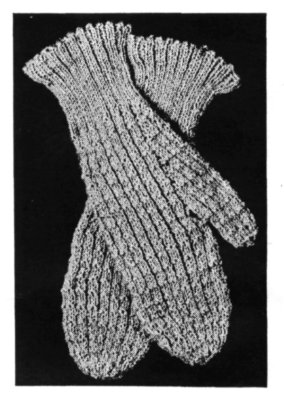
About this pattern: this is a real pattern published in 1918, reproduced word for word. Knitting terms have hardly changed since then; the few old words (such as “narrow” and “seam”) are explained in the glossary below.
Pattern (original 1918 text)
Use Saxony yarn with needles of suitable size, as you knit tight or loose. No. 17 is a good average size. Cast 18 stitches on each of three needles.
Knit 2, purl 1; repeat, until the wrist is of length desired, say two inches.
For the pattern, knit as follows:
1. Purl.
2, 3, 4. Knit 2, purl 1.
These 4 rows are repeated throughout.
Begin to widen for the thumb in the 2d row above the wrist; to widen pick up a stitch between needles and knit it, knit 1, widen, and continue in pattern. Knit 2 rows, in pattern, and again widen, knit 3, widen, across base of thumb. Continue in this way, adding 2 stitches between the widenings every 3d row, and keeping as closely as possible to the pattern, until you have 21 stitches across the thumb. Knit around twice in pattern and take the thumb-stitches off on a strong thread.
Knit around in pattern, and when you come to the thumb cast on 7 stitches, or one third the number widened for the thumb. Continue knitting the hand to the tip of the little finger, then commence narrowing. The manner in which this is done depends on the shape of the hand to be fitted. For an ordinary mitten, narrow every 5th stitch, and knit 5 times around; then narrow every 4th stitch and knit 4 times around; every 3d stitch and knit 3 times around; every 2d stitch and knit twice around; then narrow, knit 1, repeat around, knit once around, narrow every stitch, draw yarn through, and darn the end neatly and securely. It is an excellent plan to "run" the tip of a mitten on the wrong side, as you do the heel of a stocking, since it makes it wear longer, especially if intended for rough usage. The narrowing of a child's mitten may begin with every 4th stitch. Also, if the hand is long and slender, an additional row may be knitted between the widenings for the thumb.
Take the stitches off the thread on 2 needles, and with the 3d pick up and knit the stitches across the hand, which were cast on. When knitting around the first time, narrow once each end of the picked-up stitches.
Even the stitches on the needles, and knit around in pattern until you reach the base of the nail, then narrow off, beginning with once in 3 stitches. Draw through the last stitches at tip and darn down.
Old knitting terms
| In the 1918 book | Today |
|---|---|
| plain / knit plain | knit |
| purl, seam or seam-stitch | purl |
| narrow | decrease: knit 2 together (k2tog) |
| widen | increase |
| over | yarn over (yo), which makes a new stitch and a small hole |
| slip and bind | slip 1, knit 1, pass the slipped stitch over (skp) |
| slip, narrow and bind | slip 1, knit 2 together, pass the slipped stitch over (sk2p) |
| rib (when knitting plain back and forth) | a garter ridge: 2 rows make 1 rib |
| double rib | knit 2, purl 2 rib |
| bone, amber or steel needles | needles made of those materials |
| No. 11–17 steel needles | old wire-gauge numbers: the higher the number, the thinner the needle |
| Red Cross needles No. 1, 2, 3 | wartime needle sizes; choose by the gauge given (stitches per inch) |
Some knitting patterns use a crochet edging. In this book a crochet “double” is today's US single crochet (sc) and a “treble” is a US double crochet (dc).
1918 yarn names today
Approximate modern equivalents. Old yarns were often finer than today's, so knit or crochet a swatch first and compare it with any measurements the pattern gives.
| 1918 yarn | Closest modern choice |
|---|---|
| Knitting-worsted | worsted weight (#4) |
| Germantown wool or zephyr (fourfold) | roughly worsted to aran weight (#4) |
| Saxony | a fine yarn, roughly fingering to sport weight (#1–2) |
| Shetland floss | a very fine, soft wool, roughly lace to light fingering weight (#0–1) |
| Angora | a fluffy angora yarn; any soft brushed yarn gives a similar effect |
Source
Handbook of Wool Knitting and Crochet, Needlecraft Publishing Company, Augusta, Maine, 1918. This book is in the public domain in the United States. A digital edition is available free from Project Gutenberg.
More vintage knitting patterns
- Vintage basket-stitch sleeveless sweater (1918)
- Vintage winter sweater and skating cap (1918)
- Vintage child's hood, scarf and sweater set (1918)
- Vintage baby jacket and hood set (1918)
- Vintage ribbed cardigan sweater (1918)
- Vintage ladies' sweater with angora trim (1918)
- Vintage gloves with lace backs (1918)
- Vintage slippers with “ermine” trim (1918)
- All vintage knitting patterns
Looking for something new? Browse our free modern patterns, the crochet and knitting guides and the free yarn calculator.