Vintage hug-me-tight sleeveless jacket (1918)
The classic “hug-me-tight”: a cosy sleeveless jacket in double crochet with a shell at the centre back.
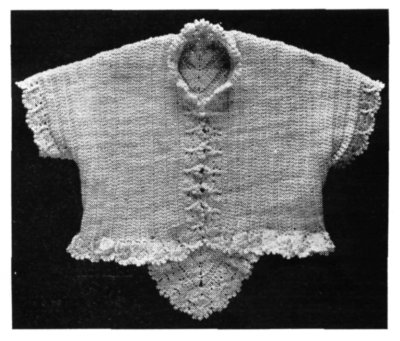
About this pattern: this is a real pattern published in 1918. The text below is the original, word for word, with only the old stitch names changed to modern US terms (so a 1918 “double” reads as “sc”). We haven't changed any stitch counts. The untouched original is further down the page.
Pattern (modern US terms)
Use Germantown worsted, white or any desired color, with a hook large enough to carry the yarn smoothly. Commence with a chain of 140 stitches, turn.
1. Miss 3, 1 dc in each of 68 stitches following, shell of 3 dc, 2 chain and 3 dc in next stitch, to widen for center of back, 1 dc in each remaining stitch, turn.
2. Chain 3 for 1st dc, 1 dc in each dc, including the 3 dc of shell, up to the 2 chain, make a shell as before under 2 chain, then 1 dc in each following to the end, turn. Work always in back vein of stitch to produce the ribbed or striped effect.
3 to 23. Same as 2d row. The jacket is now ready for joining.
Commencing at the point in center of back, count 26 stitches, then fold over and, starting from the other end of the same row, crochet the two sides together for 25 stitches, taking a stitch from each side. This will leave about 65 stitches for armscye.
For the border:
1. Shell of 6 dc in a stitch, miss 2, 1 dc in next, miss 2; repeat. Commence with 3 chain for 1st dc of 1st shell, and join to that.
2. Shell of 6 dc between 3d and 4th dc of shell in previous row, and dc in dc; repeat.
3. Chain 4, fasten back in 1st stitch for a picot, 1 sc between 2 dc, repeat, making 5 picots around the shell, 1 sc in sl st dc; repeat.
Work around the armscye in same way.
Old crochet terms
Like many books of its time, this one uses the stitch names still used in the UK today. Here's what they mean in US terms:
| In the 1918 book | Modern US term |
|---|---|
| double (d c) | single crochet (sc) |
| treble (t c) | double crochet (dc) |
| half-treble or short-treble | half double crochet (hdc) |
| double-treble (d t c) | treble (tr) |
| triple-treble (t t c) | double treble (dtr) |
| single crochet / slip | slip stitch (sl st) |
| miss | skip |
| widen / widening | increase |
| narrow | decrease |
| over | yarn over |
| vein (of the stitch) | loop: “back vein” is the back loop, “both veins” is both loops |
| needle | hook |
| bone hook | a hook made of bone; any hook of the same size works |
1918 yarn names today
Approximate modern equivalents. Old yarns were often finer than today's, so knit or crochet a swatch first and compare it with any measurements the pattern gives.
| 1918 yarn | Closest modern choice |
|---|---|
| Knitting-worsted | worsted weight (#4) |
| Germantown wool or zephyr (fourfold) | roughly worsted to aran weight (#4) |
| Saxony | a fine yarn, roughly fingering to sport weight (#1–2) |
| Shetland floss | a very fine, soft wool, roughly lace to light fingering weight (#0–1) |
| Angora | a fluffy angora yarn; any soft brushed yarn gives a similar effect |
Original 1918 text (unchanged)
Use Germantown worsted, white or any desired color, with a hook large enough to carry the yarn smoothly. Commence with a chain of 140 stitches, turn.
1. Miss 3, 1 treble in each of 68 stitches following, shell of 3 trebles, 2 chain and 3 trebles in next stitch, to widen for center of back, a treble in each remaining stitch, turn.
2. Chain 3 for 1st treble, a treble in each treble, including the 3 trebles of shell, up to the 2 chain, make a shell as before under 2 chain, then a treble in each following to the end, turn. Work always in back vein of stitch to produce the ribbed or striped effect.
3 to 23. Same as 2d row. The jacket is now ready for joining.
Commencing at the point in center of back, count 26 stitches, then fold over and, starting from the other end of the same row, crochet the two sides together for 25 stitches, taking a stitch from each side. This will leave about 65 stitches for armscye.
For the border:
1. Shell of 6 trebles in a stitch, miss 2, a treble in next, miss 2; repeat. Commence with 3 chain for 1st treble of 1st shell, and join to that.
2. Shell of 6 trebles between 3d and 4th trebles of shell in previous row, and treble in treble; repeat.
3. Chain 4, fasten back in 1st stitch for a picot, a double between 2 trebles, repeat, making 5 picots around the shell, a double in single treble; repeat.
Work around the armscye in same way.
Source
Handbook of Wool Knitting and Crochet, Needlecraft Publishing Company, Augusta, Maine, 1918. This book is in the public domain in the United States. A digital edition is available free from Project Gutenberg.
More vintage crochet patterns
- Vintage tam-o'-shanter (1918)
- Vintage crochet baby shoes (1918)
- Vintage ribbed house slippers (1918)
- Vintage bean-stitch child's cap (1918)
- Vintage crocheted jacket (1918)
- Vintage child's coat sweater (1918)
- Vintage child's jacket in star stitch (1918)
- Vintage girl's jacket (1918)
- All vintage crochet patterns
Looking for something new? Browse our free modern patterns, the crochet and knitting guides and the free yarn calculator.