Vintage tam-o'-shanter (1918)
A flat-crowned tam worked in the round in single crochet, with a fluffy angora band and a covered button on top.
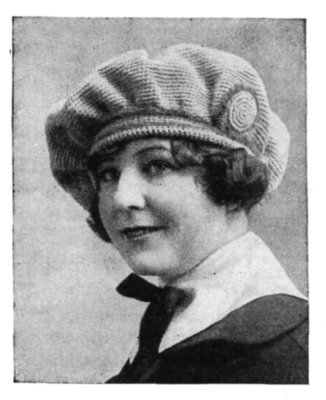
About this pattern: this is a real pattern published in 1918. The text below is the original, word for word, with only the old stitch names changed to modern US terms (so a 1918 “double” reads as “sc”). We haven't changed any stitch counts. The untouched original is further down the page.
Materials and modern suggestions
- Yarn: worsted weight (#4) for the tam and a soft, fluffy yarn (angora, mohair or a brushed yarn) for the last 2 rounds.
- Hook: the book says only “large enough to carry the yarn easily”; for worsted we'd start with 5 mm (H-8).
- Fit: the crown is a flat circle in 7 sections. Stop increasing when it is as wide as you want the tam to be.
- A large, flat button form (a self-cover button blank) for the top.
These yarn and tool suggestions are ours, to help you choose modern materials.
Pattern (modern US terms)
For the model were used one skein of electric-blue knitting-worsted and a ball of gray Angora wool, with a hook large enough to carry the yarn easily.
Make a chain of 3 stitches, join.
1. Seven sc in ring.
2. Two sc in each sc, taking both veins of stitch.
3. 1 sc in sc, 2 in next; repeat.
4. 1 sc in each of 2 sc, 2 in next; repeat.
5. 1 sc in each of 3 sc, 2 in next; repeat.
Continue in this way, adding 1 sc between widenings each row, until you have 30 sc in each section—between widenings—or more, if a larger crown is desired.
33. 1 sc in each of 7 sc, miss 1; repeat.
34. 1 sc in each of 6 sc, miss 1; repeat.
35. 1 sc in each of 2 sc, miss 1; repeat.
36 to 45. 1 sc in each stitch.
46, 47. With gray Angora wool, make 1 sc in each stitch and fasten off the last row neatly.
Cover a large, flat button-mold with the blue wool: Make a chain of 3 stitches, turn, and in 2d stitch of chain make 8 sc; make 2 sc in each of 8 sc, working in both veins of stitch; then make 1 sc in 1st stitch, 2 in next, and repeat. Continue to work around and around, widening to keep the work flat, until you have a circle which will cover the button-mold, say 6 rounds; then work once around without widening, slip in the mold, * miss 1, 1 sc in next, and repeat until the cover is closed.
For the edge of the button and the cord around top of band either the double chain may be made, an ordinary chain filled with single crochet, or—better still—the cord may be knotted by what is called the "fool's delight" method—which seems a very sensible method, indeed: Take a length of the Angora wool six times as long as the cord is wanted to be; indeed, it will be better to start with a longer piece, for fear it may "take up" more rapidly than anticipated. Make a slip or half knot at one end of the yarn, pass the other end down through this to form a loop, then tie the ends of the yarn together. Hold this knot between thumb and forefinger of one hand (say the right), with the yarn which pulls through the half knot under the same hand, and the loop which was formed held on the forefinger, holding the yarn which does not pull in the left hand; pass the forefinger of left hand through the loop on right forefinger from front to back, catch up and draw through the non-pulling or left-hand thread—exactly as you would make a chain-stitch in crochet—transfer the knot which ties the two ends together to thumb and forefinger of left hand, keeping the loop over forefinger, and draw up the pulling yarn, or that passed originally through the half knot. Now the position of the loop, pulling yarn and knot is exactly the same in the left hand as formerly in the right. Continue by passing forefinger of right hand through the loop on left forefinger, catching up the non-pulling thread and drawing it through to form the new loop (on right forefinger again), transfer the knot from left hand to right, and pull up, repeating the process from beginning. This is really a sort of double chain, and when one has learned to make it evenly and well—as may be done with a little practise—it will be found superior for bags, lingerie, and many other articles requiring a drawstring or a cord.
Sew this cord evenly around button and top of band, and the cap is completed.
Old crochet terms
Like many books of its time, this one uses the stitch names still used in the UK today. Here's what they mean in US terms:
| In the 1918 book | Modern US term |
|---|---|
| double (d c) | single crochet (sc) |
| treble (t c) | double crochet (dc) |
| half-treble or short-treble | half double crochet (hdc) |
| double-treble (d t c) | treble (tr) |
| triple-treble (t t c) | double treble (dtr) |
| single crochet / slip | slip stitch (sl st) |
| miss | skip |
| widen / widening | increase |
| narrow | decrease |
| over | yarn over |
| vein (of the stitch) | loop: “back vein” is the back loop, “both veins” is both loops |
| needle | hook |
| bone hook | a hook made of bone; any hook of the same size works |
1918 yarn names today
Approximate modern equivalents. Old yarns were often finer than today's, so knit or crochet a swatch first and compare it with any measurements the pattern gives.
| 1918 yarn | Closest modern choice |
|---|---|
| Knitting-worsted | worsted weight (#4) |
| Germantown wool or zephyr (fourfold) | roughly worsted to aran weight (#4) |
| Saxony | a fine yarn, roughly fingering to sport weight (#1–2) |
| Shetland floss | a very fine, soft wool, roughly lace to light fingering weight (#0–1) |
| Angora | a fluffy angora yarn; any soft brushed yarn gives a similar effect |
Original 1918 text (unchanged)
For the model were used one skein of electric-blue knitting-worsted and a ball of gray Angora wool, with a hook large enough to carry the yarn easily.
Make a chain of 3 stitches, join.
1. Seven doubles in ring.
2. Two doubles in each double, taking both veins of stitch.
3. A double in double, 2 in next; repeat.
4. A double in each of 2 doubles, 2 in next; repeat.
5. A double in each of 3 doubles, 2 in next; repeat.
Continue in this way, adding 1 double between widenings each row, until you have 30 doubles in each section—between widenings—or more, if a larger crown is desired.
33. A double in each of 7 doubles, miss 1; repeat.
34. A double in each of 6 doubles, miss 1; repeat.
35. A double in each of 2 doubles, miss 1; repeat.
36 to 45. A double in each stitch.
46, 47. With gray Angora wool, make a double in each stitch and fasten off the last row neatly.
Cover a large, flat button-mold with the blue wool: Make a chain of 3 stitches, turn, and in 2d stitch of chain make 8 doubles; make 2 doubles in each of 8 doubles, working in both veins of stitch; then make 1 double in 1st stitch, 2 in next, and repeat. Continue to work around and around, widening to keep the work flat, until you have a circle which will cover the button-mold, say 6 rounds; then work once around without widening, slip in the mold, * miss 1, a double in next, and repeat until the cover is closed.
For the edge of the button and the cord around top of band either the double chain may be made, an ordinary chain filled with double crochet, or—better still—the cord may be knotted by what is called the "fool's delight" method—which seems a very sensible method, indeed: Take a length of the Angora wool six times as long as the cord is wanted to be; indeed, it will be better to start with a longer piece, for fear it may "take up" more rapidly than anticipated. Make a slip or half knot at one end of the yarn, pass the other end down through this to form a loop, then tie the ends of the yarn together. Hold this knot between thumb and forefinger of one hand (say the right), with the yarn which pulls through the half knot under the same hand, and the loop which was formed held on the forefinger, holding the yarn which does not pull in the left hand; pass the forefinger of left hand through the loop on right forefinger from front to back, catch up and draw through the non-pulling or left-hand thread—exactly as you would make a chain-stitch in crochet—transfer the knot which ties the two ends together to thumb and forefinger of left hand, keeping the loop over forefinger, and draw up the pulling yarn, or that passed originally through the half knot. Now the position of the loop, pulling yarn and knot is exactly the same in the left hand as formerly in the right. Continue by passing forefinger of right hand through the loop on left forefinger, catching up the non-pulling thread and drawing it through to form the new loop (on right forefinger again), transfer the knot from left hand to right, and pull up, repeating the process from beginning. This is really a sort of double chain, and when one has learned to make it evenly and well—as may be done with a little practise—it will be found superior for bags, lingerie, and many other articles requiring a drawstring or a cord.
Sew this cord evenly around button and top of band, and the cap is completed.
Source
Handbook of Wool Knitting and Crochet, Needlecraft Publishing Company, Augusta, Maine, 1918. This book is in the public domain in the United States. A digital edition is available free from Project Gutenberg.
More vintage crochet patterns
- Vintage crochet baby shoes (1918)
- Vintage ribbed house slippers (1918)
- Vintage bean-stitch child's cap (1918)
- Vintage crocheted jacket (1918)
- Vintage hug-me-tight sleeveless jacket (1918)
- Vintage child's coat sweater (1918)
- Vintage child's jacket in star stitch (1918)
- Vintage girl's jacket (1918)
- All vintage crochet patterns
Looking for something new? Browse our free modern patterns, the crochet and knitting guides and the free yarn calculator.