Vintage Red Cross muffler (1918)
A plain garter-stitch muffler, 68 inches long, from the 1918 Red Cross knitting instructions.
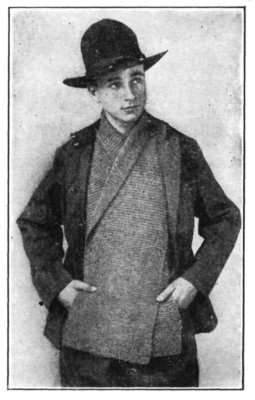
About this pattern: this is a real pattern published in 1918, reproduced word for word. Knitting terms have hardly changed since then; the few old words (such as “narrow” and “seam”) are explained in the glossary below.
Pattern (original 1918 text)
Two and one-half skeins of knitting-yarn and one pair amber needles No. 5, or Red Cross needles No. 3 will be required. Cast on 50 stitches, measuring 11 inches, and knit back and forth until the muffler is sixty-eight inches in length.
Old knitting terms
| In the 1918 book | Today |
|---|---|
| plain / knit plain | knit |
| purl, seam or seam-stitch | purl |
| narrow | decrease: knit 2 together (k2tog) |
| widen | increase |
| over | yarn over (yo), which makes a new stitch and a small hole |
| slip and bind | slip 1, knit 1, pass the slipped stitch over (skp) |
| slip, narrow and bind | slip 1, knit 2 together, pass the slipped stitch over (sk2p) |
| rib (when knitting plain back and forth) | a garter ridge: 2 rows make 1 rib |
| double rib | knit 2, purl 2 rib |
| bone, amber or steel needles | needles made of those materials |
| No. 11–17 steel needles | old wire-gauge numbers: the higher the number, the thinner the needle |
| Red Cross needles No. 1, 2, 3 | wartime needle sizes; choose by the gauge given (stitches per inch) |
Some knitting patterns use a crochet edging. In this book a crochet “double” is today's US single crochet (sc) and a “treble” is a US double crochet (dc).
1918 yarn names today
Approximate modern equivalents. Old yarns were often finer than today's, so knit or crochet a swatch first and compare it with any measurements the pattern gives.
| 1918 yarn | Closest modern choice |
|---|---|
| Knitting-worsted | worsted weight (#4) |
| Germantown wool or zephyr (fourfold) | roughly worsted to aran weight (#4) |
| Saxony | a fine yarn, roughly fingering to sport weight (#1–2) |
| Shetland floss | a very fine, soft wool, roughly lace to light fingering weight (#0–1) |
| Angora | a fluffy angora yarn; any soft brushed yarn gives a similar effect |
Source
Handbook of Wool Knitting and Crochet, Needlecraft Publishing Company, Augusta, Maine, 1918. This book is in the public domain in the United States. A digital edition is available free from Project Gutenberg.
More vintage knitting patterns
- Vintage basket-stitch sleeveless sweater (1918)
- Vintage winter sweater and skating cap (1918)
- Vintage child's hood, scarf and sweater set (1918)
- Vintage baby jacket and hood set (1918)
- Vintage ribbed cardigan sweater (1918)
- Vintage ladies' sweater with angora trim (1918)
- Vintage gloves with lace backs (1918)
- Vintage slippers with “ermine” trim (1918)
- All vintage knitting patterns
Looking for something new? Browse our free modern patterns, the crochet and knitting guides and the free yarn calculator.