Vintage baby jacket (1918)
A dainty baby jacket in Saxony yarn with a silk edging and a ribbon tie.
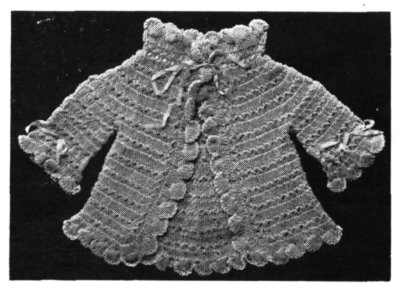
About this pattern: this is a real pattern published in 1918. The text below is the original, word for word, with only the old stitch names changed to modern US terms (so a 1918 “double” reads as “sc”). We haven't changed any stitch counts. The untouched original is further down the page.
Pattern (modern US terms)
Materials required are three skeins of Saxony yarn, one spool silk-finished crochet-cotton or crochet-silk, and two and one-half yards of No. 1 ribbon. Use a hook which will carry the yarn easily.
Make a chain of 100 stitches, turn.
1. Miss 1st 4 stitches, make 1 dc in each of 96 stitches, drawing up to about five-eighths of an inch. Break and fasten wool (this so the work will be done on the right side; one may turn, if preferred, but the effect is not so good).
2. Fasten in where you began, pull up, make 2 dc in top of 3d dc and 1 dc back to where you fastened in, which makes a cross; repeat, making 32 crosses in all; break thread and again join in at the end where you began.
3. Make 21 dc over 7 crosses, (12 dc over next 2, 18 dc over 6 crosses) twice, 12 over 2, and again 21 over 7, which brings you to end of row. The 12 dc over 2 are to widen; the others are made 2 on each cross and 1 between.
4. Same as 2d row, 38 crosses.
5. Make 21 dc plain (that is, 3 over each cross). 24 over 4 crosses, 21 plain, 12 over 2 crosses, 21 plain, 24 over next 4, 21 plain.
6. Forty-eight crosses.
7. Make 21 plain, 12 over next 2 crosses, 12 plain, (12 over next 2, 24 plain) twice, 12 over next 2, 12 plain, 12 over next 2, 21 plain.
8. Fifty-eight crosses.
9. Make 24 plain, miss 12 crosses, 24 plain, 12 over next 2, 24 plain, miss 12 crosses, 24 plain.
10. Thirty-six crosses.
11. Plain, with 3 extra dc under each arm, and 6 extra over the 6 crosses at center of back.
12. Forty crosses.
13. Plain, with 6 extra in back.
14. Forty-two crosses.
15. Like 13th row.
16. Forty-four crosses.
17. Like 13th row.
18. Forty-six crosses.
19. Plain, without widening in the back.
Around the neck make spaces for the ribbon by fastening in at end of foundation-chain, chain 5, miss 2, 1 dc in next, * chain 2, miss 2, 1 dc, and repeat. Now make a row of crosses entirely around the jacket, putting extra crosses at corners to keep the work flat, follow this with a row of dc, widening by making extra dc at corners to turn them nicely, finish with a row of shells of 8 dc in a stitch, miss 3, fasten, miss 3; repeat, and edge with the crochet-silk, making 1 sc between 1st 2 dc of shell, (chain 2, 1 sc between next 2) 6 times, chain 2, sc in sc between shells, chain 2, and repeat.
For the sleeves:
1. Make 6 dc on dc under the arm, and 36 over the 12 crosses.
2. Fourteen crosses.
3. Plain, with 3 extra dc under arm, 45 in all.
4. Fifteen crosses.
5. Same as 3d row, making 48 dc.
6. Sixteen crosses.
7. Same as 3d row, making 51 dc.
8. Seventeen crosses.
9. Same as 3d row, making 54 dc.
Finish with shells and chain-loops, as described for the body of jacket. Run one and one-fourth yards of ribbon in the neck, and divide the remainder, running it in the 7th row of sleeve and making a pretty bow on top.
Old crochet terms
Like many books of its time, this one uses the stitch names still used in the UK today. Here's what they mean in US terms:
| In the 1918 book | Modern US term |
|---|---|
| double (d c) | single crochet (sc) |
| treble (t c) | double crochet (dc) |
| half-treble or short-treble | half double crochet (hdc) |
| double-treble (d t c) | treble (tr) |
| triple-treble (t t c) | double treble (dtr) |
| single crochet / slip | slip stitch (sl st) |
| miss | skip |
| widen / widening | increase |
| narrow | decrease |
| over | yarn over |
| vein (of the stitch) | loop: “back vein” is the back loop, “both veins” is both loops |
| needle | hook |
| bone hook | a hook made of bone; any hook of the same size works |
1918 yarn names today
Approximate modern equivalents. Old yarns were often finer than today's, so knit or crochet a swatch first and compare it with any measurements the pattern gives.
| 1918 yarn | Closest modern choice |
|---|---|
| Knitting-worsted | worsted weight (#4) |
| Germantown wool or zephyr (fourfold) | roughly worsted to aran weight (#4) |
| Saxony | a fine yarn, roughly fingering to sport weight (#1–2) |
| Shetland floss | a very fine, soft wool, roughly lace to light fingering weight (#0–1) |
| Angora | a fluffy angora yarn; any soft brushed yarn gives a similar effect |
Original 1918 text (unchanged)
Materials required are three skeins of Saxony yarn, one spool silk-finished crochet-cotton or crochet-silk, and two and one-half yards of No. 1 ribbon. Use a hook which will carry the yarn easily.
Make a chain of 100 stitches, turn.
1. Miss 1st 4 stitches, make a treble in each of 96 stitches, drawing up to about five-eighths of an inch. Break and fasten wool (this so the work will be done on the right side; one may turn, if preferred, but the effect is not so good).
2. Fasten in where you began, pull up, make 2 trebles in top of 3d treble and 1 treble back to where you fastened in, which makes a cross; repeat, making 32 crosses in all; break thread and again join in at the end where you began.
3. Make 21 trebles over 7 crosses, (12 trebles over next 2, 18 trebles over 6 crosses) twice, 12 over 2, and again 21 over 7, which brings you to end of row. The 12 trebles over 2 are to widen; the others are made 2 on each cross and 1 between.
4. Same as 2d row, 38 crosses.
5. Make 21 trebles plain (that is, 3 over each cross). 24 over 4 crosses, 21 plain, 12 over 2 crosses, 21 plain, 24 over next 4, 21 plain.
6. Forty-eight crosses.
7. Make 21 plain, 12 over next 2 crosses, 12 plain, (12 over next 2, 24 plain) twice, 12 over next 2, 12 plain, 12 over next 2, 21 plain.
8. Fifty-eight crosses.
9. Make 24 plain, miss 12 crosses, 24 plain, 12 over next 2, 24 plain, miss 12 crosses, 24 plain.
10. Thirty-six crosses.
11. Plain, with 3 extra trebles under each arm, and 6 extra over the 6 crosses at center of back.
12. Forty crosses.
13. Plain, with 6 extra in back.
14. Forty-two crosses.
15. Like 13th row.
16. Forty-four crosses.
17. Like 13th row.
18. Forty-six crosses.
19. Plain, without widening in the back.
Around the neck make spaces for the ribbon by fastening in at end of foundation-chain, chain 5, miss 2, a treble in next, * chain 2, miss 2, 1 treble, and repeat. Now make a row of crosses entirely around the jacket, putting extra crosses at corners to keep the work flat, follow this with a row of trebles, widening by making extra trebles at corners to turn them nicely, finish with a row of shells of 8 trebles in a stitch, miss 3, fasten, miss 3; repeat, and edge with the crochet-silk, making a double between 1st 2 trebles of shell, (chain 2, a double between next 2) 6 times, chain 2, double in double between shells, chain 2, and repeat.
For the sleeves:
1. Make 6 trebles on trebles under the arm, and 36 over the 12 crosses.
2. Fourteen crosses.
3. Plain, with 3 extra trebles under arm, 45 in all.
4. Fifteen crosses.
5. Same as 3d row, making 48 trebles.
6. Sixteen crosses.
7. Same as 3d row, making 51 trebles.
8. Seventeen crosses.
9. Same as 3d row, making 54 trebles.
Finish with shells and chain-loops, as described for the body of jacket. Run one and one-fourth yards of ribbon in the neck, and divide the remainder, running it in the 7th row of sleeve and making a pretty bow on top.
Source
Handbook of Wool Knitting and Crochet, Needlecraft Publishing Company, Augusta, Maine, 1918. This book is in the public domain in the United States. A digital edition is available free from Project Gutenberg.
More vintage crochet patterns
- Vintage tam-o'-shanter (1918)
- Vintage crochet baby shoes (1918)
- Vintage ribbed house slippers (1918)
- Vintage bean-stitch child's cap (1918)
- Vintage crocheted jacket (1918)
- Vintage hug-me-tight sleeveless jacket (1918)
- Vintage child's coat sweater (1918)
- Vintage child's jacket in star stitch (1918)
- All vintage crochet patterns
Looking for something new? Browse our free modern patterns, the crochet and knitting guides and the free yarn calculator.